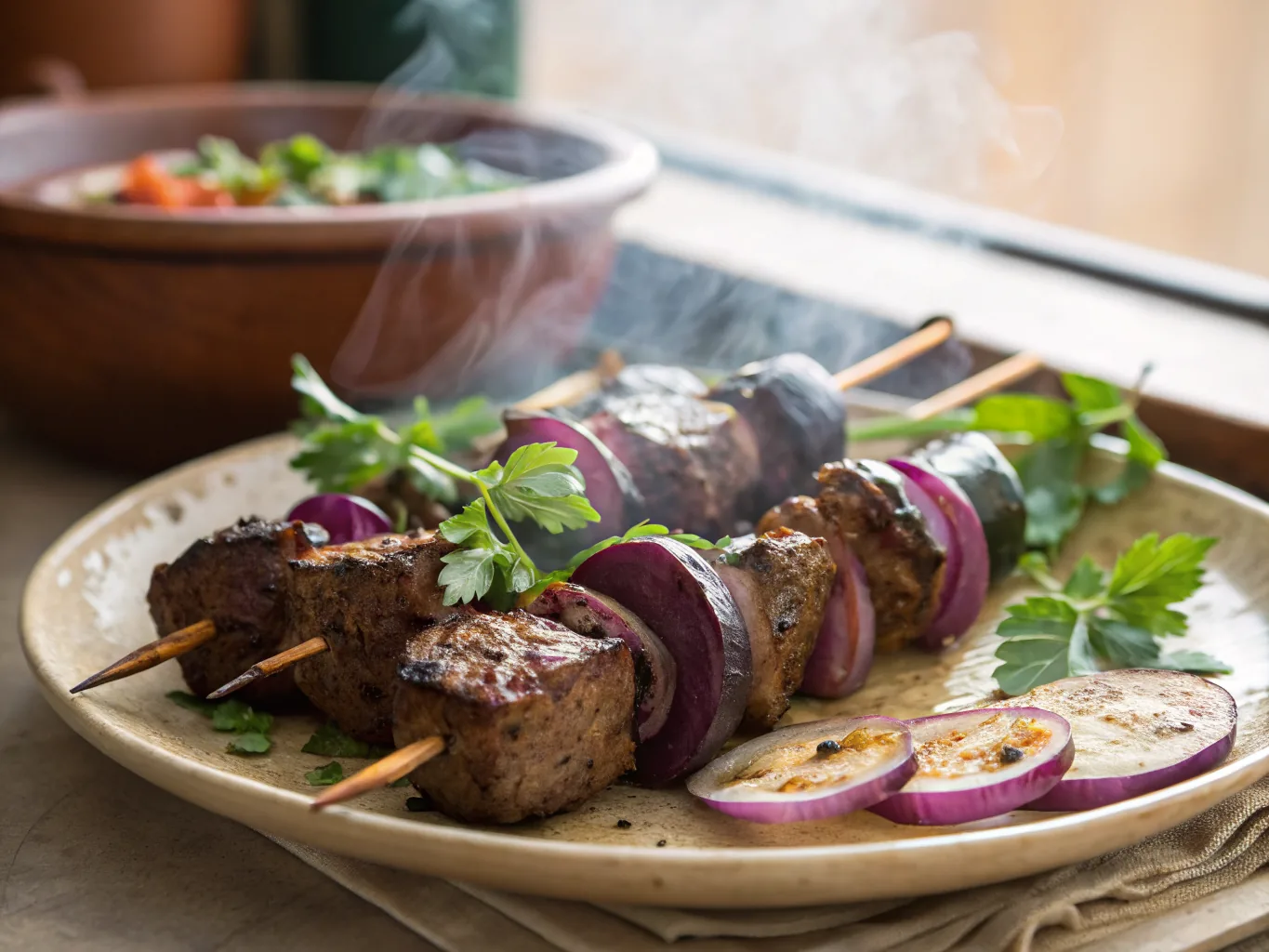
Picture a courtyard in Gaziantep on a July evening, where the smell of charcoal and cumin drifts over stone walls and neighbors drift toward the grill without being asked. Kebab culture in Turkey is not a restaurant invention; it is a household rhythm tied to the seasons, the butcher, and the garden. The spiced lamb and eggplant kebab with sumac onions sits at the center of that rhythm, and it happens to be one of the most quietly sustainable dishes in the Mediterranean repertoire. Eggplant peaks in late summer when lamb is also at its most abundant, and the two are cooked together over a single fire. Nothing is wasted: the fat bastes the vegetable, the vegetable catches the drippings, and the raw onion salad uses up the last of the allium crop. In this article, you will learn how this dish fits into a lower-footprint kitchen, where its flavors come from, and the small techniques that make it work. The promise is simple: by the time you finish, you will see a skewer of lamb and eggplant not as an indulgence, but as a sensible, seasonal, and deeply satisfying way to eat.
Why This Kebab Is a Seasonal, Local Dish at Heart
Eggplant is one of the most heat-loving crops in the Mediterranean, and in Turkey it comes into its own from July through September, when the fruit is glossy, dense, and low in seed. Outside that window, imported eggplant travels thousands of kilometers and often arrives mealy. Lamb mince follows a parallel calendar. Traditional Turkish sheep breeds such as the Awassi and the Daglic are grass-fed and fattened on pasture, and their meat is richest in late spring and early summer. The kebab's genius is that it pairs a late-summer vegetable with a meat that is at its best in the same months. Sumac, meanwhile, is harvested in August from wild shrubs across Anatolia and the Levant, then dried and ground. A single dish therefore draws on three harvests that overlap for only a few weeks a year, which is exactly why it tastes so vivid. Cooking it in season is not a sacrifice; it is the point. Buy eggplant from a farmers market, ask your butcher when the lamb was raised, and the dish costs less carbon and less money while tasting better than any out-of-season version.
Whole-Animal Cooking and the Case for 20% Fat
The recipe calls for lamb mince with roughly 20 percent fat, and that number is not arbitrary. Fat carries the volatile compounds of cumin and garlic, keeps the kebab juicy over high heat, and bastes the eggplant as it chars. But the sustainability argument runs deeper. Choosing fattier mince lets you use cuts that supermarkets struggle to sell, such as shoulder, breast, and trimmings from the leg. When a butcher grinds these together, the whole animal is used rather than only the premium loin, and the environmental cost per kilogram of meat drops because fewer parts go to waste. According to food-waste researchers, meat is among the most resource-intensive foods to discard, so using every cut matters. Ask your butcher to grind shoulder with a little breast fat, or buy whole cuts and grind at home in a food processor. The result is a kebab that is juicier than lean mince ever produces, and a purchase that supports the nose-to-tail logic that has always governed Anatolian butchery. Fat, in this dish, is a form of respect.
The Anatolian Roots of a Skewered Tradition
Kebab is a word that predates the Ottoman Empire, and its meaning is narrow: grilled meat. The skewered, minced version known as kebab is associated with the southeastern city of Adana, where a lamb-and-tail-fat mixture is pressed onto flat iron skewers and grilled over oak charcoal. The eggplant-and-lamb pairing belongs to a broader Anatolian pattern called patlicanli, meaning with eggplant, which appears in stews, stuffed dishes, and grilled preparations across the region. Sumac onions, called sumakli sogan, are a fixture of southeastern and eastern Mediterranean tables, served raw and sharp beside anything rich. The dish as a whole reflects the food culture of a region that has fed travelers, farmers, and traders for centuries: meat stretched with vegetables, acid cutting fat, and bread completing the meal. It is not a restaurant plate so much as a family habit, and its balance of meat and vegetable is a template that many contemporary chefs are now rediscovering for both health and environmental reasons.
Pro Tip: Salt the Eggplant, Then Grill It Before It Touches the Meat
Most home cooks skewer raw eggplant alongside raw lamb and end up with a vegetable that is either undercooked or collapsed. The fix is a two-step method that professional grill cooks use. First, slice the eggplant into thick planks, salt them lightly, and let them sit for fifteen to twenty minutes. The salt draws out water and collapses the spongy cell structure, which means the eggplant will absorb less oil and hold its shape on the skewer. Second, grill or sear the eggplant planks for two to three minutes per side before threading them with the lamb, so they are already partly cooked and slightly charred. When they finish over the fire, the lamb fat drips onto them and adds smoke and richness without turning them to mush. This order of operations also shortens total grill time, which means less charcoal burned, a smaller carbon footprint, and fewer flare-ups. A simple trick, but it transforms the texture of the dish and makes the eggplant the star rather than the filler.
How This Dish Fits the Modern Sustainable Kitchen
Sustainability in cooking is rarely about grand gestures. It is about the small, repeatable choices that define a household's weekly rhythm. This kebab embodies several of them at once. It uses a vegetable at peak season, when it needs the least transport and the fewest inputs. It uses whole-animal mince, which reduces waste at the butcher counter. It is grilled over a single heat source rather than three separate pans, cutting energy use. The sumac onions are made from raw ingredients with no packaging, and any leftover onion can be pickled in vinegar rather than discarded. Even the stems and seeds of the eggplant can go into a stock. Nutritionally, the dish balances protein with fiber and antioxidants; eggplant skin contains nasunin, a compound that has drawn interest for its antioxidant activity, and sumac is rich in organic acids that support digestion. In a culinary landscape increasingly focused on plant-forward eating, the kebab is a useful model: meat treated as a seasoning and a treat, not the whole plate.
Frequently Asked Questions
Q: Can I make this kebab with less lamb or a plant-based mince? A: Yes. Reduce the lamb by a third and increase the eggplant, or substitute a firm plant-based mince. Keep the cumin, garlic, and Aleppo pepper, and add a spoonful of olive oil to replace the lamb fat's moisture. Q: Is sumac essential, or can I substitute it? A: Sumac brings a tart, citrusy note with no liquid, which is hard to replicate exactly. Lemon zest plus a pinch of salt is the closest substitute, but use it sparingly so the onions do not become wet. Q: How do I keep the kebabs from sticking to the grill? A: Oil the grate, not the skewers, and let the kebabs sit undisturbed for the first two to three minutes. The meat will release naturally once a crust forms. Soak wooden skewers for thirty minutes first.
Key Takeaways
Treat this kebab as a seasonal dish and it will reward you twice, with better flavor and a lighter footprint. Buy eggplant in late summer from a local grower, and ask your butcher for shoulder-and-fat mince so the whole animal is used. Salt and pre-grill the eggplant before threading it with the lamb; this single step fixes the most common failure of home kebabs and reduces grill time. Make sumac onions fresh and keep any leftovers in vinegar to pickle rather than throw away. Finally, think of meat as a flavoring rather than the center of the plate, and let the vegetable carry the meal. These are small choices, but repeated across a summer of grilling, they add up to a kitchen that eats well and wastes little. Light the coals, gather a few friends, and taste a little piece of Anatolia.
Try these recipes on DishIndex
Explore lamb eggplant kebab recipes and more